FinVault
a Smarter way to see your money.
An AI-powered personal finance companion that turns scattered expenses, budgets, bills and investments into one calm, actionable view — designed for young professionals in India.
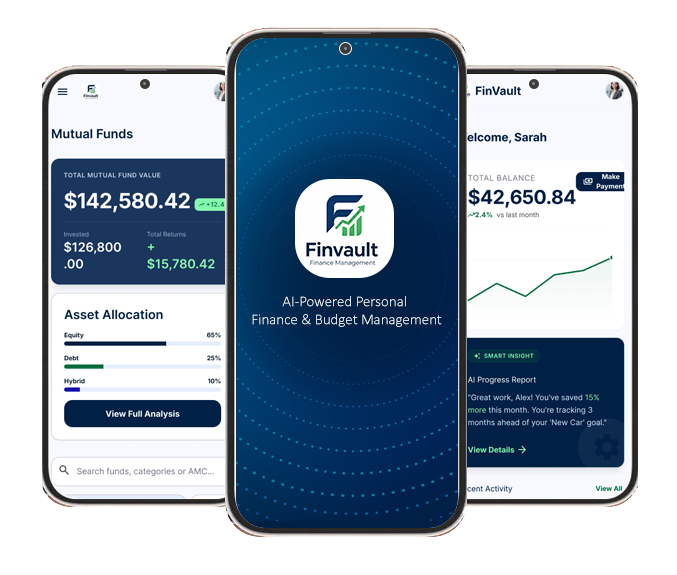
Target usability outcomes.
Case-study evaluation results from concept usability tests. Not measured production analytics.
The project in one story.
Situation
Young professionals were juggling expenses, budgets, savings, investments and bills across multiple apps and manual tools — 88% didn't know where their money went; 72% forgot bill dates.
Task
Design a centralized personal finance experience that makes money easier to understand while helping users track spending, plan budgets, save, invest and pay bills.
Action
Conducted research with 20 professionals, competitive analysis, personas, journey mapping, IA, flows, wireframes, hi-fi UI, an AI insights concept, prototyping and usability validation.
Result
96% task success, expense entry from 65s to 22s, 4.8/5 dashboard satisfaction, +38% budget completion, +42% savings-goal engagement.
Money shouldn't feel like a mystery.
Young professionals struggle to manage personal finances because their expenses, budgets, savings, investments and billsare fragmented across multiple apps, spreadsheets and reminders — making it difficult to understand and control overall financial health..
None of these tools talk to each other. The user becomes the aggregator — remembering, forwarding and double-checking across all of them, every single month.

Fragmented finance
Every payday starts with the same question — where did last month go?
Connected finance
One calm home for expenses, budgets, goals, bills and investments — with an AI advisor that speaks in your context, not in jargon.
Personal finance is not one task.
People earn regularly but often can't answer where their money went. Existing tools force users to switch between banking apps, spreadsheets, reminders, investment platforms and budgeting apps.



I studied the behavior behind the balance sheet.
The goal was to understand how young professionals actually manage money today — the workarounds, the anxiety, and the invisible coordination happening across apps.
Research findings are based on documented concept research and interviews with 20 working professionals (age 22–45, income ₹25K–₹2L/month). Target outcomes are design success criteria, not measured production results..
Existing products solved parts of the problem.
Each product owned one slice of the journey — but nobody connected expenses, budgets, bills, savings and investments into one calm experience with personal guidance.
| Product | Strength | Opportunity |
|---|---|---|
| Walnut | Automatic expense tracking | Outdated UI |
| Money Manager | Powerful financial reports | Complex navigation |
| Credit Karma | Complete financial overview | Information overload |
| YNAB | Strong budgeting method | Steep learning curve |
| Cred | Beautiful bill payments | Limited savings & investments |
Combine expenses + budgets + bills + savings + investments — with an AI advisor that feels personal, trustworthy and quietly present.
Designed for the paycheck-to-planner professional — and the goal-setter next door.
Two patterns emerged: high-earning professionals losing money to lifestyle drift, and disciplined savers who want AI to compound their habits.
Aditi Menon
28 · Bengaluru · Product Manager · ₹1.2L/mo
- Salaried, 3 bank accounts, 6 subscriptions
- Uses UPI daily · rarely opens banking apps
- Sets SIPs but forgets to track them
- Wants simple visibility, not lectures
- Cares about privacy and consent
Rohan Iyer
34 · Pune · Marketing Lead · ₹1.8L/mo
- Family financial responsibilities
- Runs monthly budgets in a spreadsheet
- Tracks 4 investment platforms
- Wants forecast + goal readiness
- Prefers actionable AI nudges over charts
Four gaps kept surfacing.
Didn't know where money went
Users had a general sense of income but no clear map of monthly outflow.
Forgot bill payment dates
Late fees and reminders were the top source of financial stress.
Never tracked monthly budgets
Budgeting felt punitive or too tedious to maintain.
Wanted personalized advice
Users trusted AI only if it felt specific — not generic tips.
From research to design principles.
Centralize
One place for the entire financial picture.
Simplify
Reduce cognitive load — remove finance jargon.
Prioritize
Show what matters today, not everything at once.
Personalize
AI recommendations rooted in the user's own data.
Support
Coach with encouragement, never with guilt.
Protect
Consent, privacy and transparent data handling.
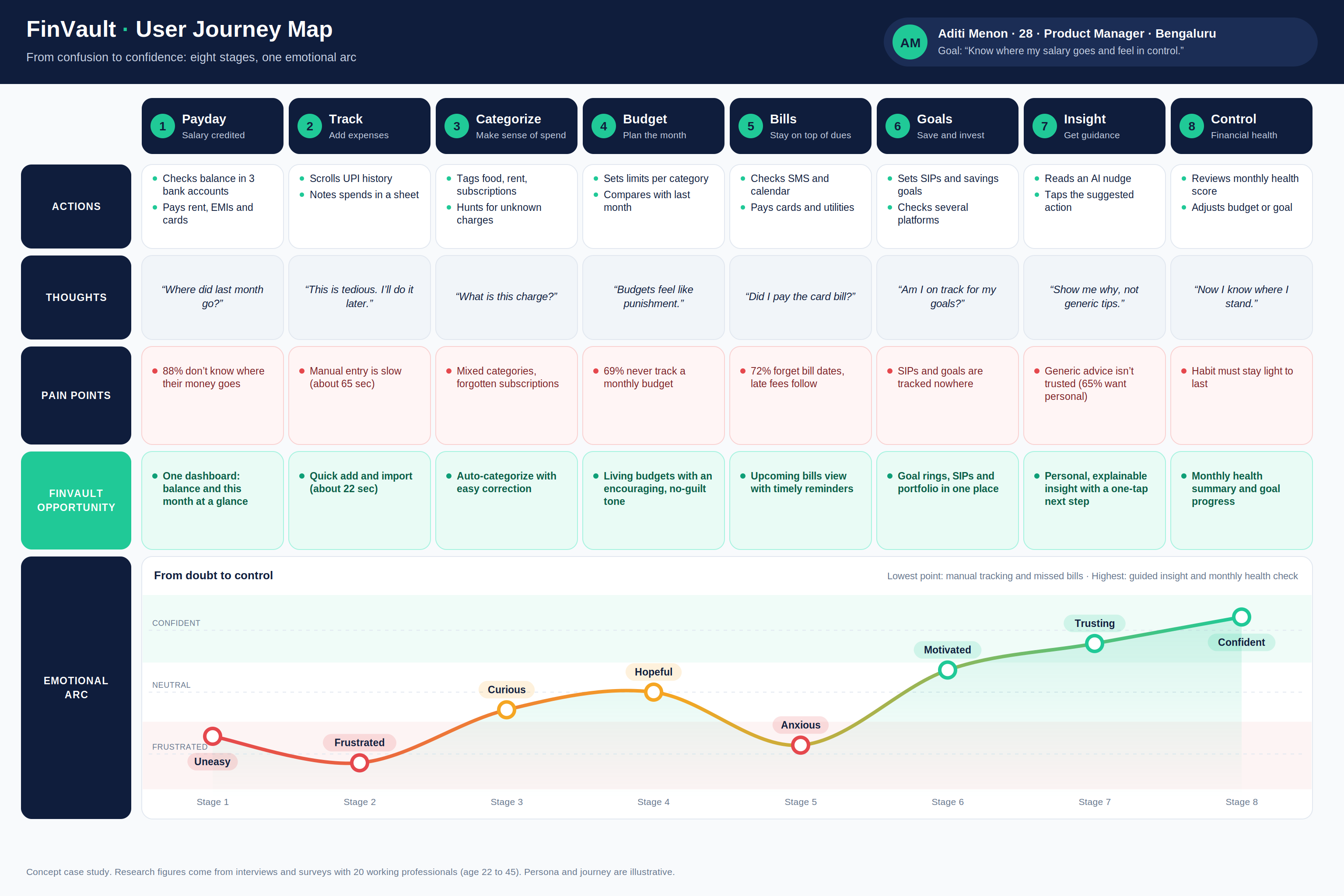
From confusion to confidence.
Eight stages, one emotional arc — from doubt to control.
Simplifying the money ecosystem.
Five primary destinations, each with a small, predictable set of features.
Home
Money
Goals
Invest
Bills
From adding an expense to a personalized insight.
Every step feeds the next — tracking creates categories, categories power budgets, budgets shape insights, insights shape decisions.
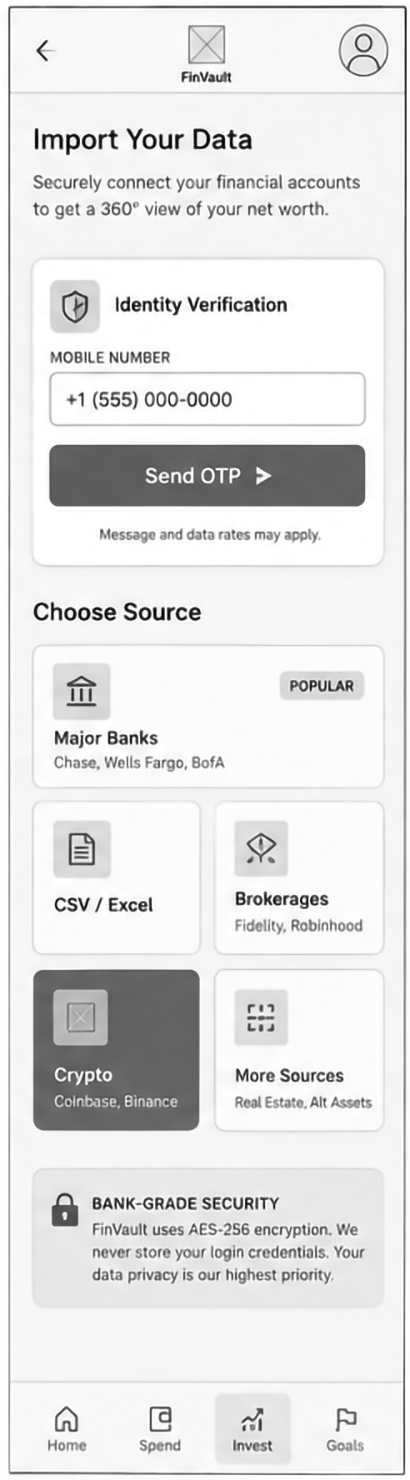
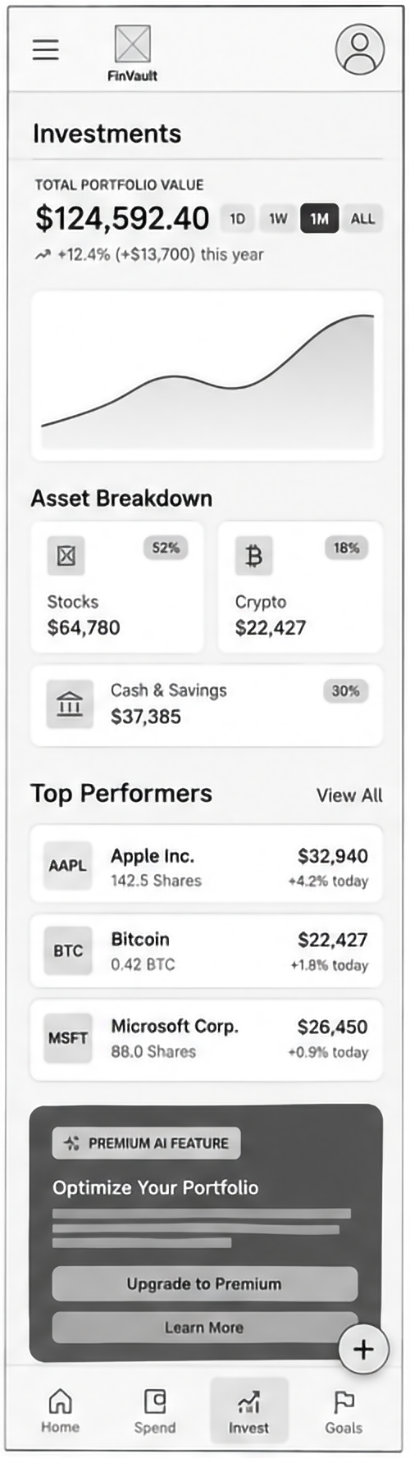
Wireframes


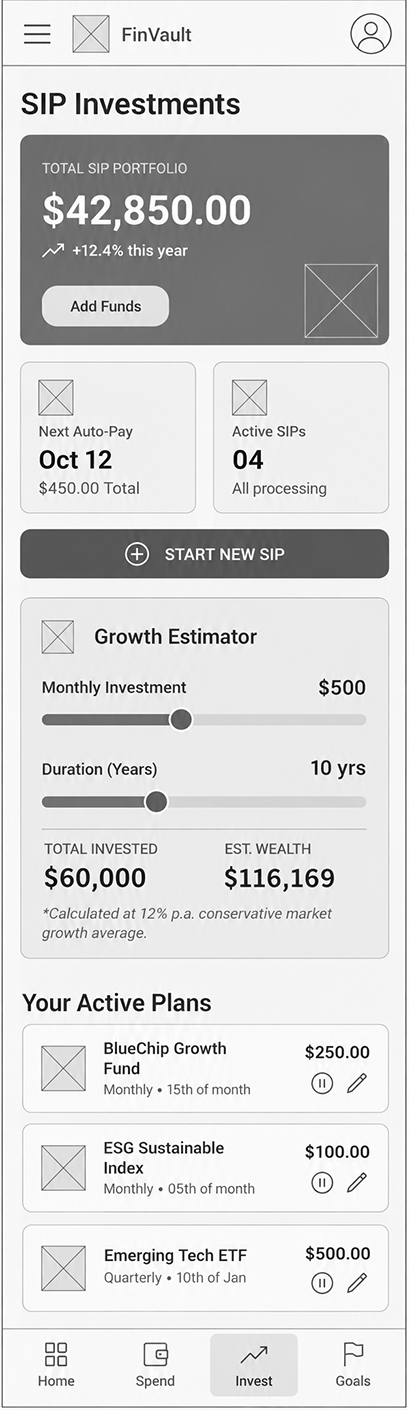
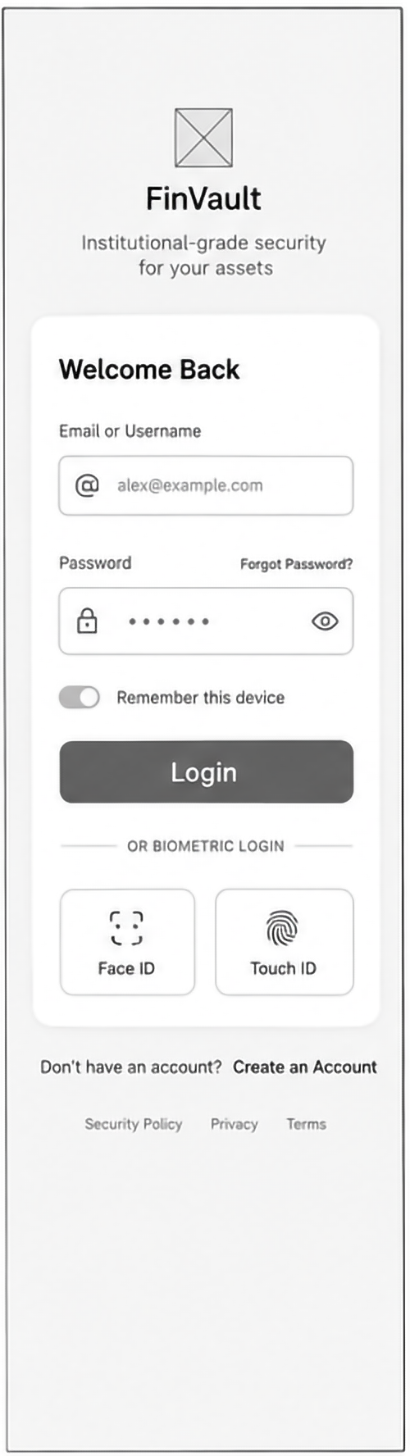
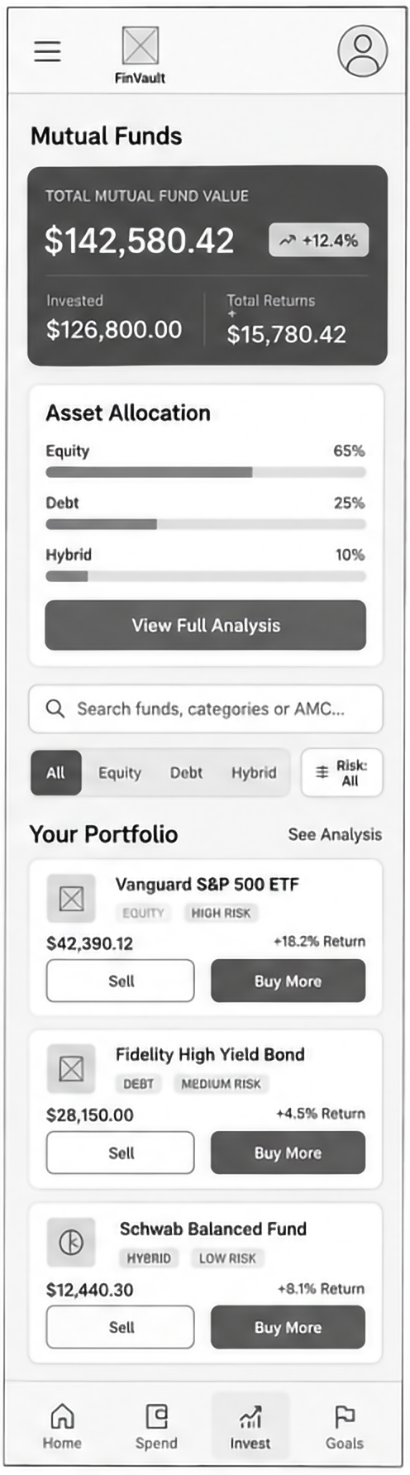
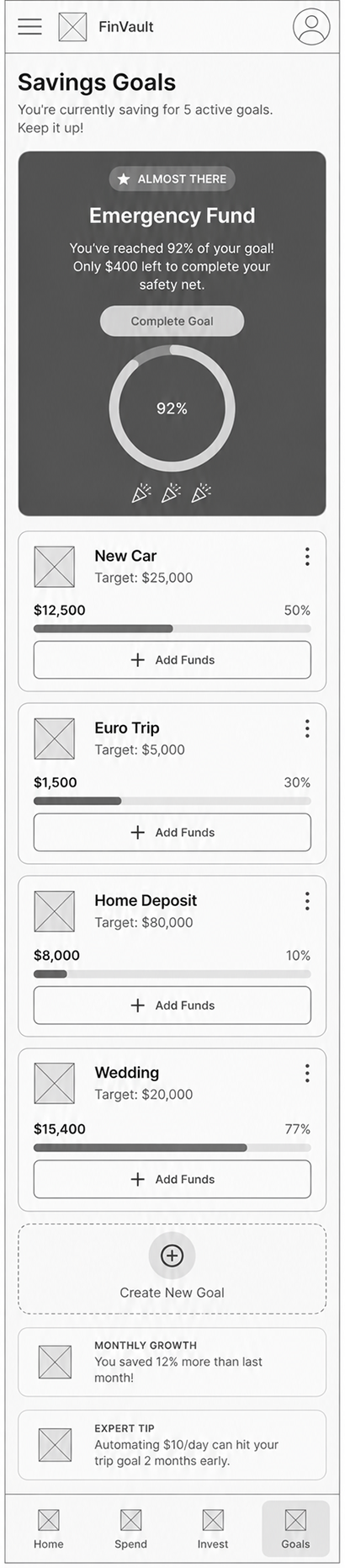
High-Fidelity Mockups
One connected place for the user's money.
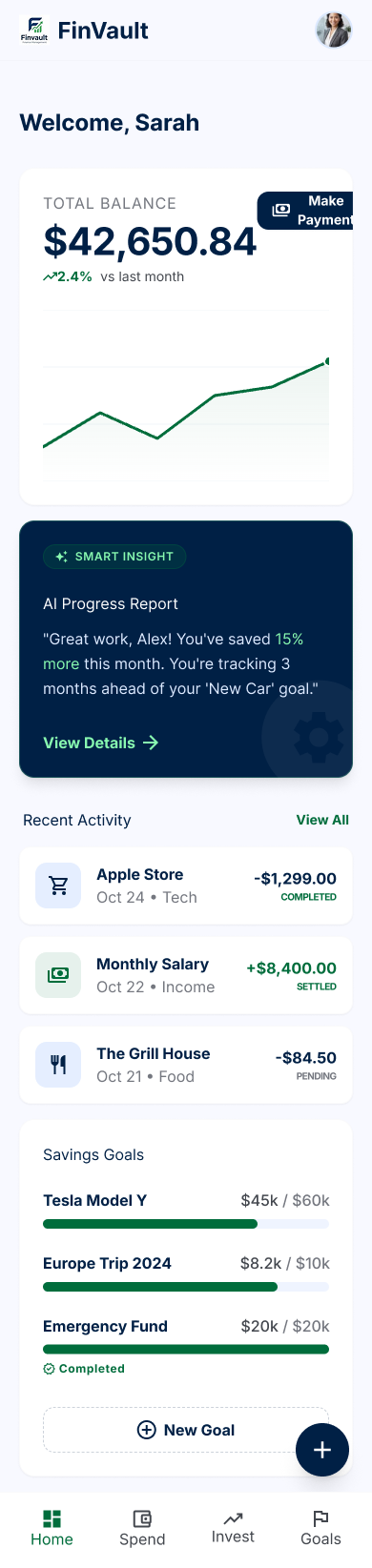
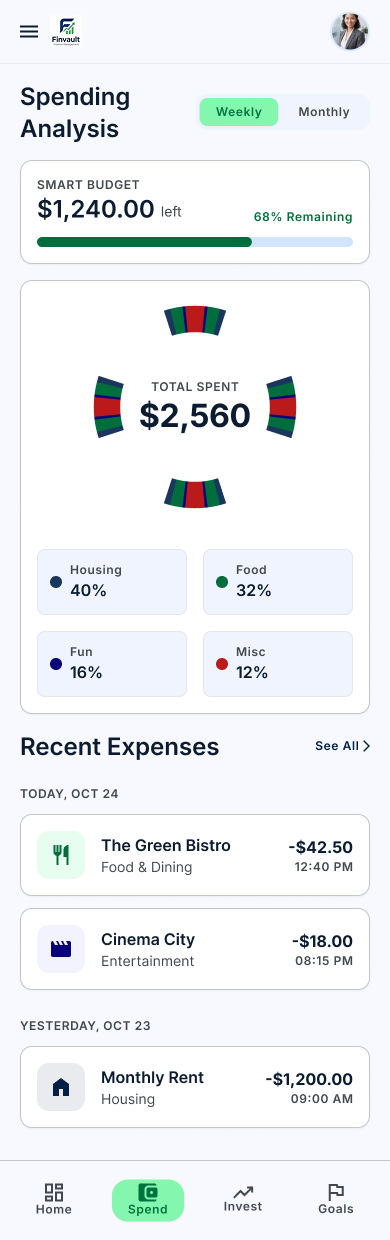
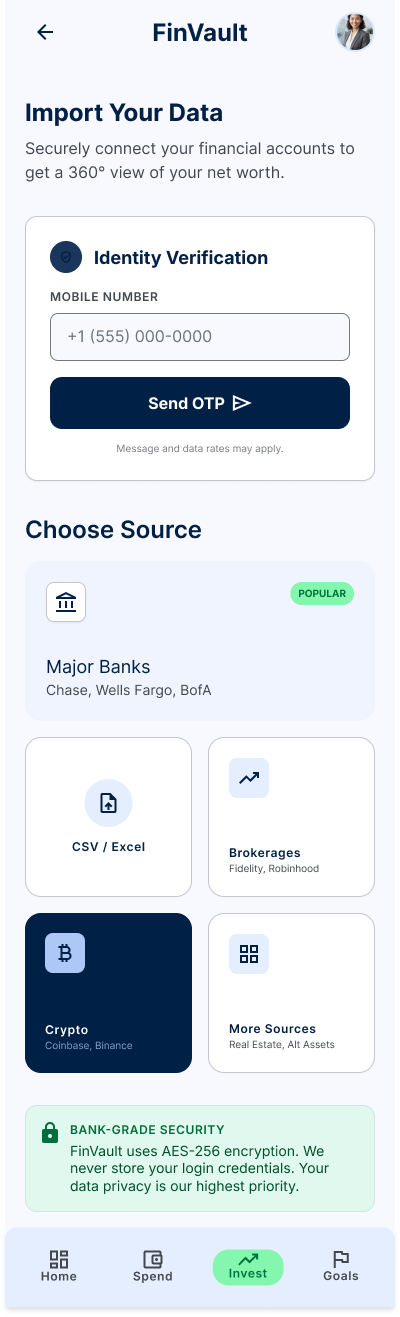
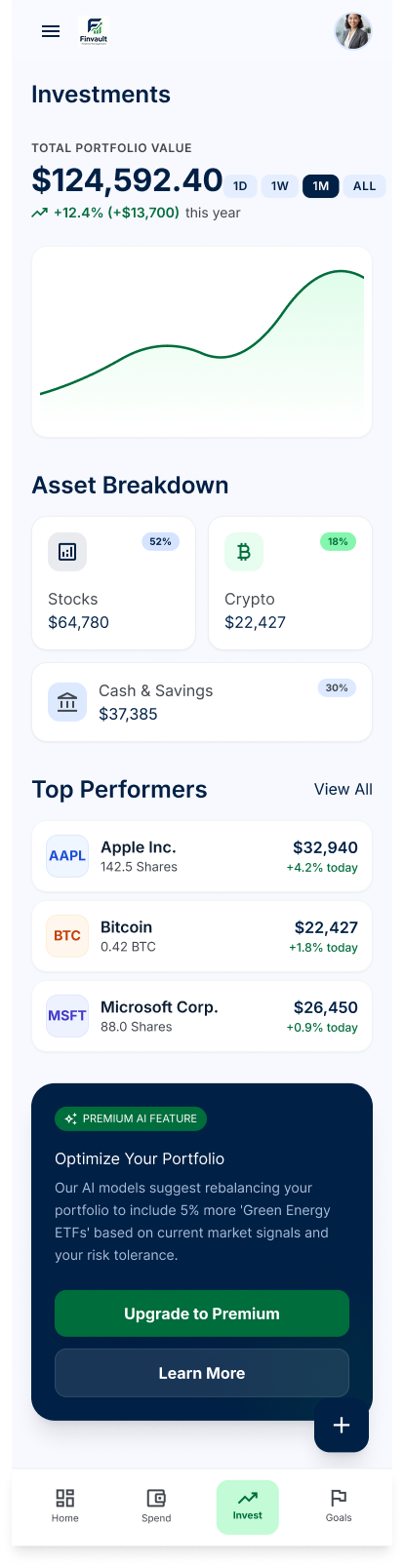
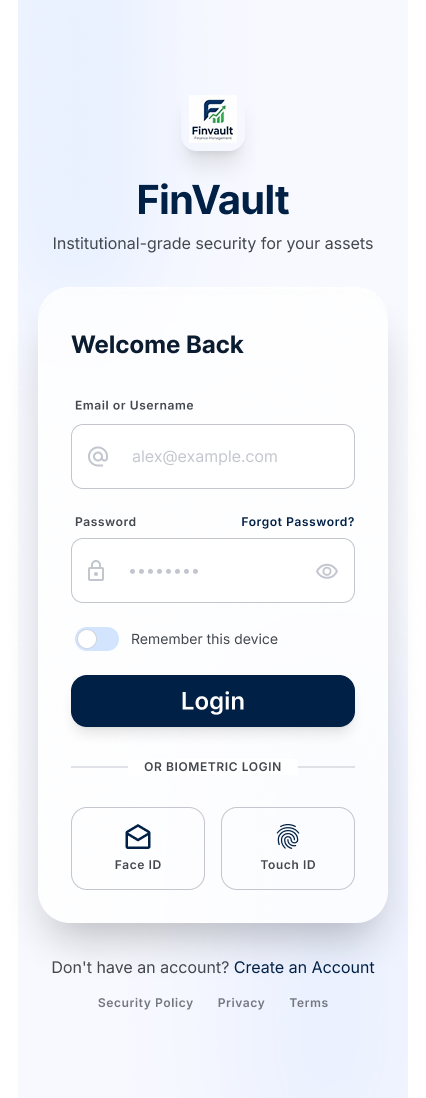


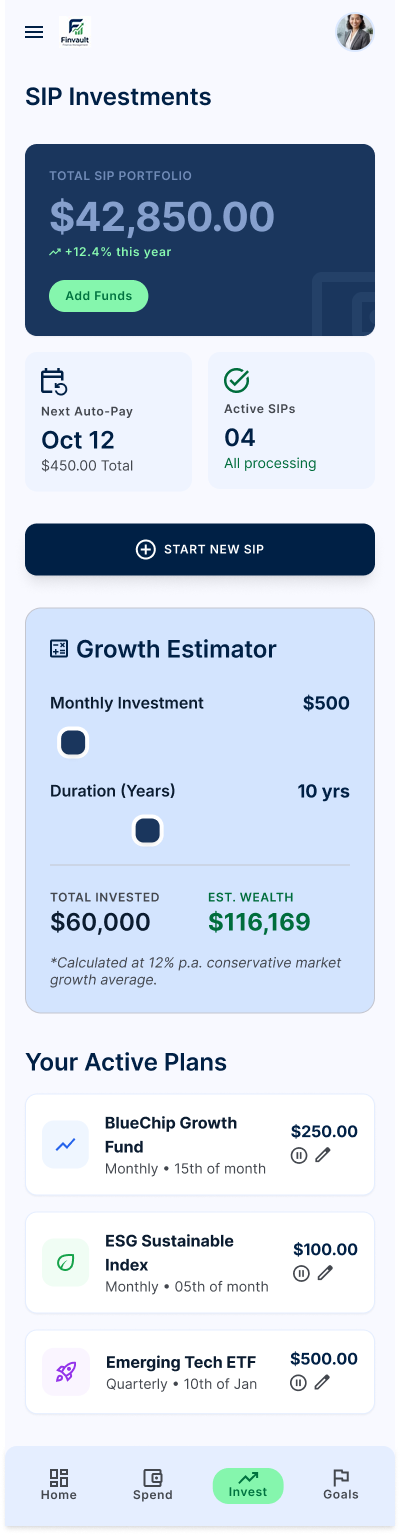
Less noise. More meaningful nudges.
Users ignore generic notifications. FinVault's AI advisor speaks in the user's own context — grounded in their actual spending, timed to when they can act.
A visual system built for trust and clarity.
A compact, systematic kit — every screen in FinVault is composed from the same small set of calm, consistent parts.
Money, made calm
Display / Questrial · one family, consistent weights
Body — Roboto. Simple, systematic UI copy across every screen.
Designing responsibly for money.
Financial design carries real responsibility. These were treated as design inputs, not compliance checkboxes.
Accessibility
- WCAG 2.2 AA target
- Readable numerals
- Color-independent status
- Reduced cognitive load
Privacy
- Consent-based access
- Account Aggregator ready
- Transparent AI reasoning
- Sensitive data protection
Indian context
- DPDP Act, 2023
- RBI guidelines aware
- UPI & recurring commitments
- Salary-driven cycles
These are design considerations for a real-world product, not certification claims. FinVault is a conceptual UX/product design project.
From financial fog to quiet confidence.
- Scattered accounts
- Missed bills
- Untracked budgets
- Guilt-driven guidance
- High cognitive load
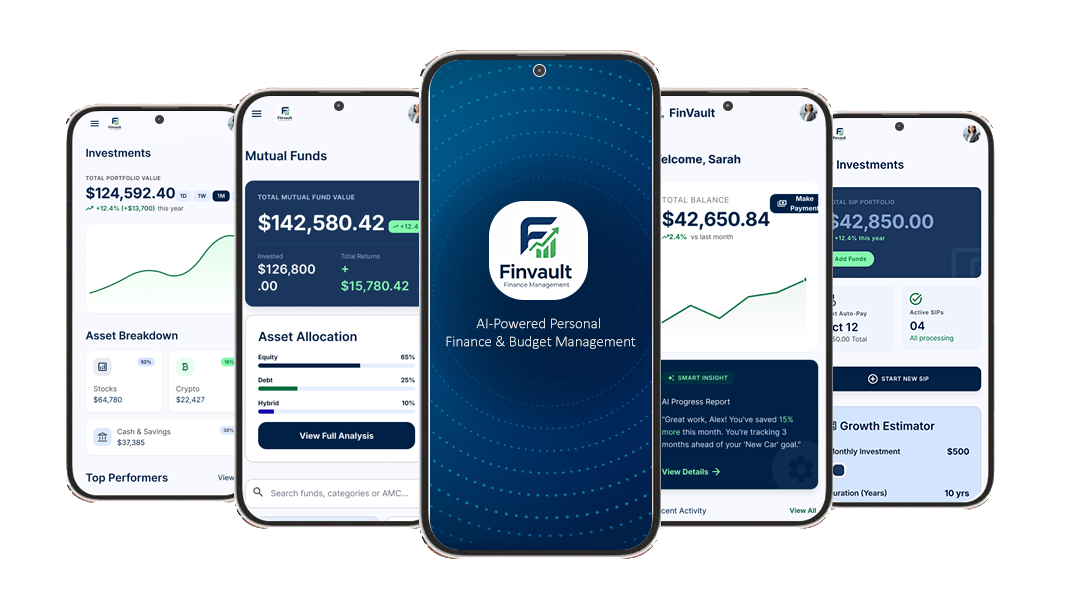
- Centralized picture
- Timely reminders
- Living budgets
- Personal AI guidance
- Calmer money mind
What I learned.
Simplifying complexity beats adding features.
The value came from removing noise — not by stacking more dashboards on top.
AI must feel personal to be trusted.
Users don't want generic tips. They want insights grounded in their own numbers.
Money design is emotional design.
Financial UX succeeds when it lowers anxiety, not just when it lowers taps.