The item data analyst
Data accuracy & submission
- Works across thousands of item records
- Needs fast validation and bulk editing
- Owns data exceptions and resubmissions
“Show me what’s wrong, why it matters and how to fix it.”
A retailer data sync and compliance platform that helps CPG suppliers catch errors before they become rejected orders.
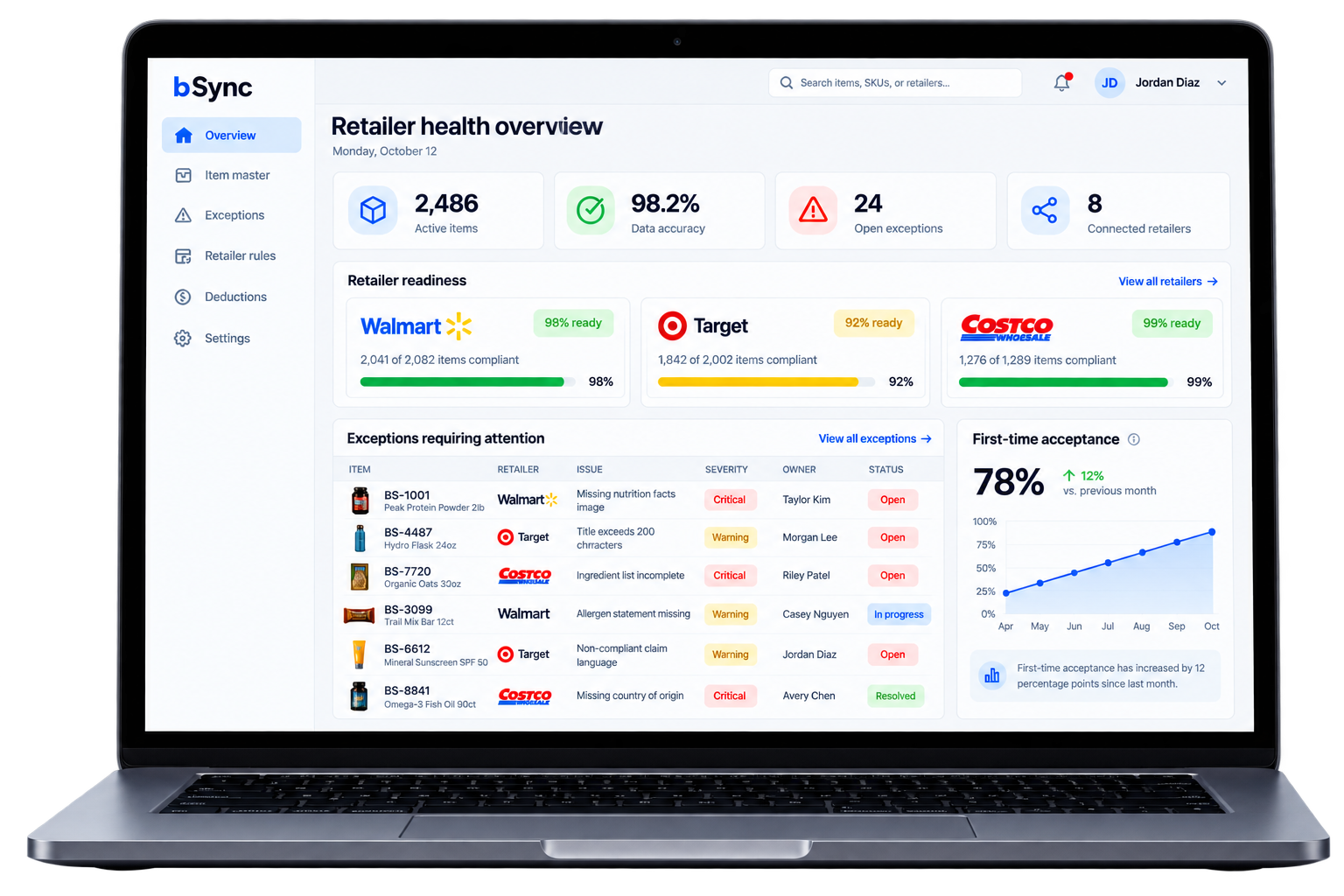
Results reported for individual suppliers using the bSync platform. They are not attributable to design alone.
Suppliers lost sales and margin when data mismatches caused rejected orders, penalties and payment deductions. Teams discovered problems too late.
Create one trustworthy experience that validates data before submission, explains exceptions and helps every role take the right action.
Map the order-to-cash journey, explore user needs, define the information architecture, prototype key workflows and iterate through usability testing.
A unified design concept connecting item records, retailer rules, exception resolution and deduction tracing, shifting the focus from reaction to prevention. Individual suppliers reported fewer order rejections and improved data-sync accuracy after adopting the platform.
Supplier and retailer systems don’t always agree. When discrepancies are found only after an order is submitted,the cost goes far beyond correcting a field.

Scattered records, manual checks, unclear errors and costly deductions. Every exception becomes another fire drill.
One validated item record, clear retailer rules and actionable fixes — with an owner and an audit trail.
Months of work go into getting a product retail-ready. Then an incorrect dimension, an outdated price or a missing field can stop the shipment and trigger a penalty.
It was a connected workflow that prevents errors at the source. Give analysts a clear fix, account managers an early view of risk, and finance a traceable path from a deduction to its data cause.



The proposed research approach examines the workarounds, handoffs and invisible expertise that keep supplier operations moving.
Each system had its strengths. The opportunity was to connect product information, retailer requirements and corrective action in one place.
| Existing approach | Strength | Opportunity |
|---|---|---|
| Retailer portals | Authoritative retailer requirements | One retailer at a time; fragmented workflows |
| Product information tools | Strong product data models | Not designed around retailer compliance |
| BI dashboards | Visibility and historical reporting | Reactive rather than preventive |
| Spreadsheets & email | Flexible and familiar | No automated validation or reliable audit trail |
Unify item data + retailer rules + pre-submission validation + clear exception resolution.
Catch mismatches before submission, not after rejection.
Show the field, the rule and the next best action.
Make urgent exceptions visible without creating alarm.
Use spreadsheet-like patterns for high-volume data work.
Trace each item across retailers, orders and deductions.
Make ownership, permissions and every change transparent.
Designed for supplier teams working with large datasets, complex retailer rules and a common need for speed, accuracy and traceability.
Data accuracy & submission
“Show me what’s wrong, why it matters and how to fix it.”
Retailer relationships & readiness
“I need to know we’re ready before the retailer places an order.”
Deductions & reconciliation
“Help me trace the deduction back to what actually happened.”
Teams reconcile the same records across spreadsheets, portals and internal systems.
Mismatches are discovered after rejection, when the cost of correction is already high.
An error code adds work when it does not explain the field, rule or next action.
Retailer-specific knowledge lives with individuals rather than in a shared, reliable system.
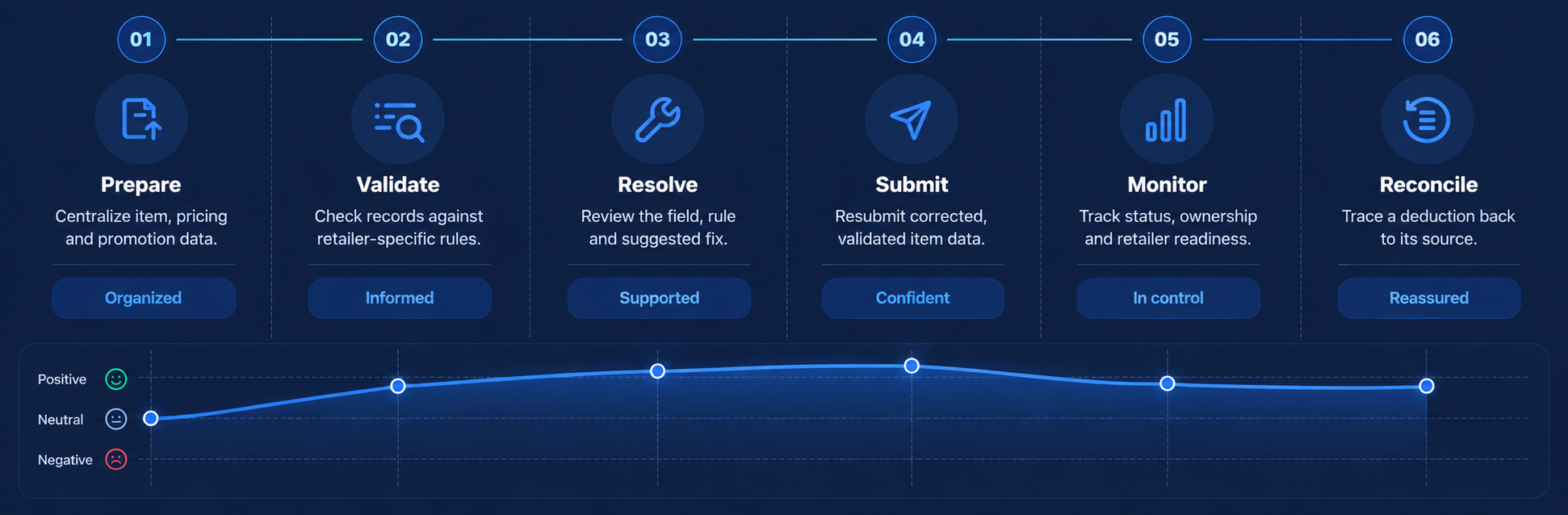
A connected path from preparing product data to reconciling payment — with a clear next step at every stage.
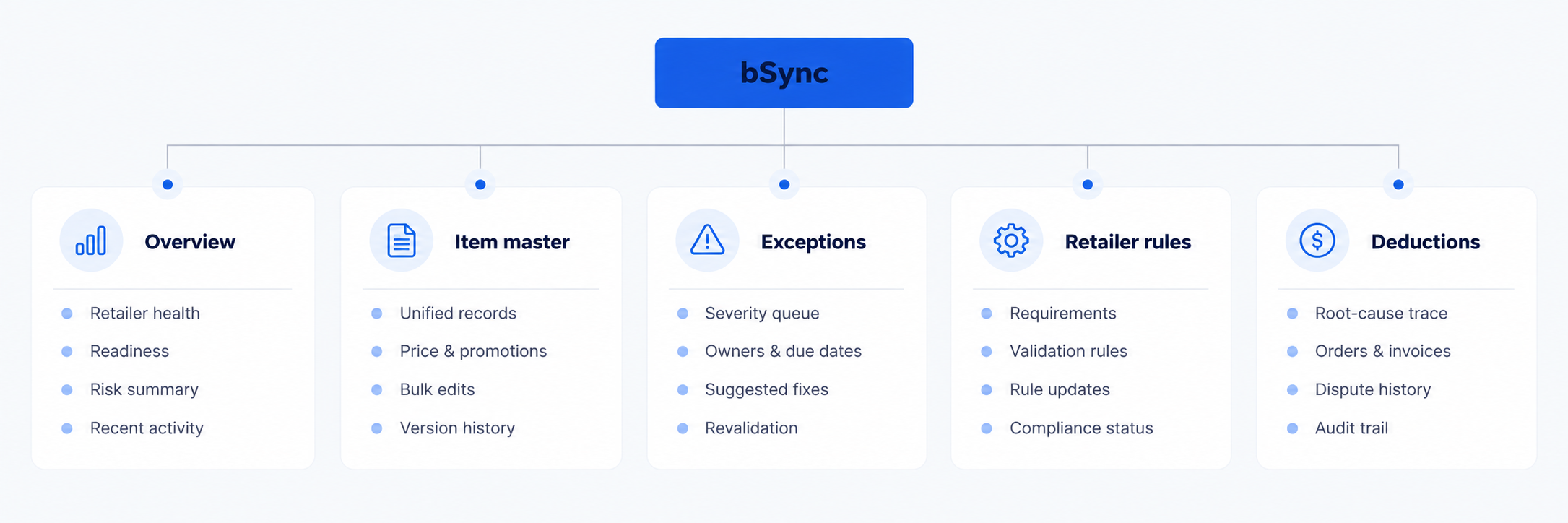
Five core destinations organize the supplier’s work, with shared item records connecting the whole experience.
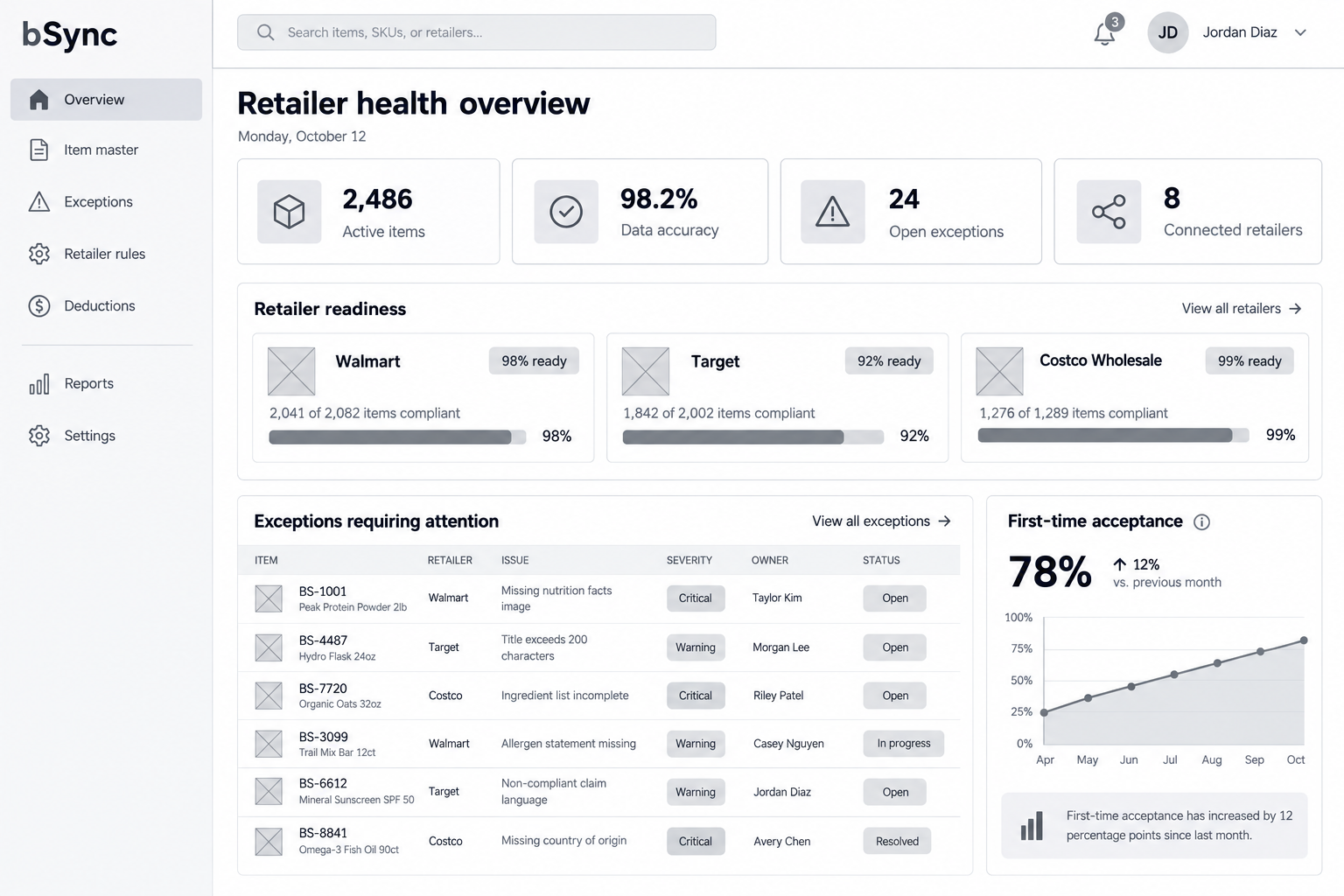
Validation is not a dead end. It connects the issue to a rule, a fix and a confident resubmission.
Meet bSync. One connected view of retail readiness.
A calm, focused workspace that makes risk visible and turns dense product data into clear, actionable decisions.
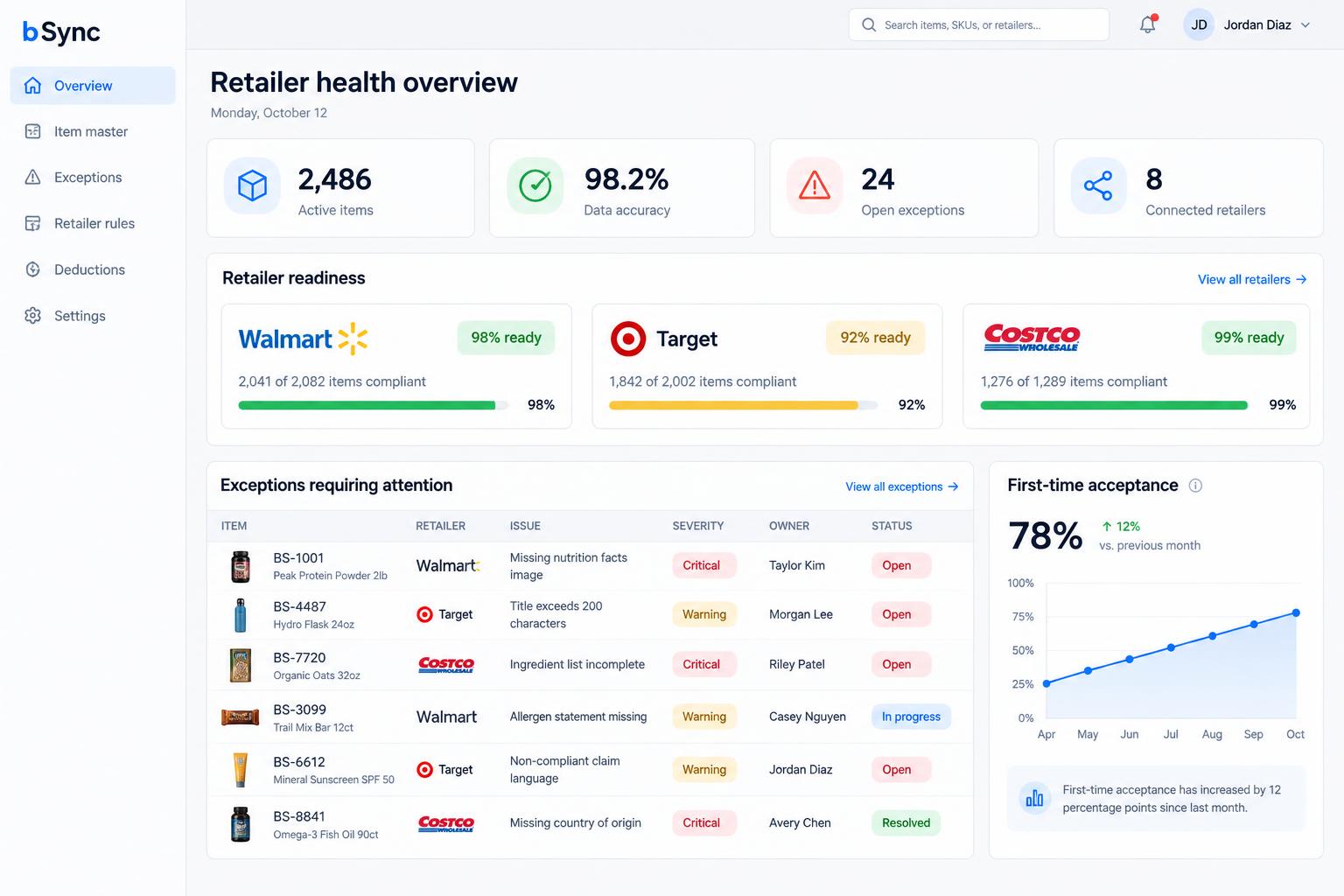
Users ignore error codes that don’t say what to do. bSync explains each exception in the context of the retailer’s rule and the item’s own data.
A restrained neutral foundation, one electric-blue accent and semantic status colors — supporting dense information without adding visual noise.
Core palette
#2563EB
Primary actions, links and highlights.
#FFFFFF
Clean backgrounds for content and layouts.
#F3F6FB
Cards, panels and secondary sections.
#0F1D3C
Headings and primary text.
Typography · Inter
One family. Clear hierarchy. Comfortable reading and compact data views.
H1
32 / Bold
Quick fox
H2
24 / Semibold
Quick fox
H3
20 / Semibold
Quick fox
Body
16 / Regular
The quick brown fox
Caption
14 / Regular
The quick brown fox
Label
12 / Medium
Quick brown fox
WCAG 2.2 AA is the design target: readable contrast, visible focus, and status communicated through text and icons.
Explicit role-based permissions and an item-level audit trail are core product requirements.
A 12-column layout, reusable patterns and density options support large datasets and distributed teams.
Retail compliance data carries real financial consequences. These were treated as design inputs, not compliance checkboxes.
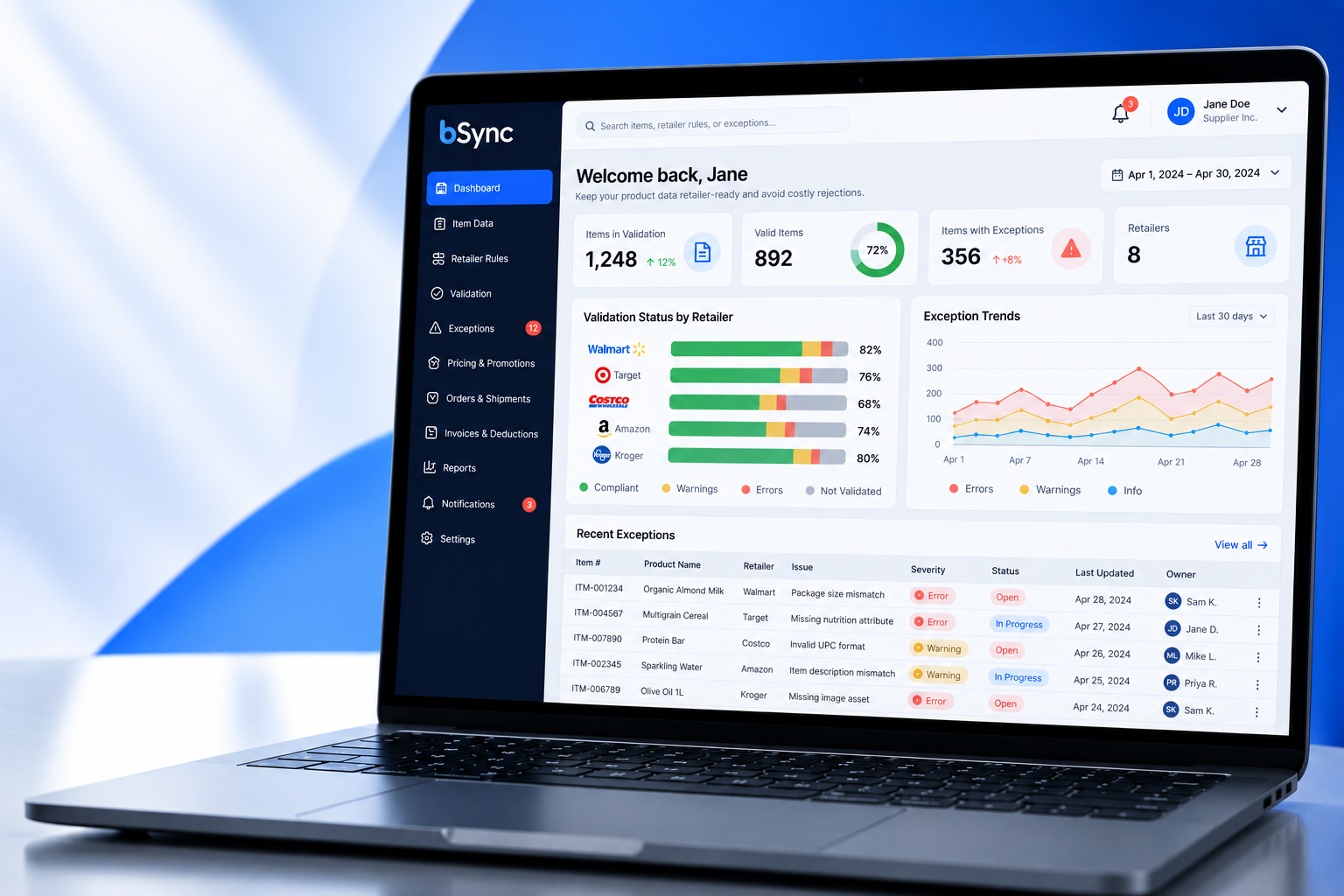
This project frames compliance as a design problem, not just a rules problem. The experience should help people act earlier, understand the consequences and trust the system.
Less manual reconciliation. Clearer ownership. Fewer avoidable handoffs. A connected view that gives analysts, account teams and finance a common language.
Confirm actual project dates and contributions, validate the proposed workflows with supplier teams, and establish baselines for rejection rate, resolution time and deduction value.