Product Design Case Study

bSure confident credit decisions, in near real time.

A cloud-based credit management platform that moves enterprise credit teams from paperwork, email chains and guesswork to one calm, auditable workflow.

Role
Product Design
Timeline
4 Months
Domain
Enterprise FinTech
Client
Vertex CS
Tools
Figma · Research · IA · User Flows · Wireframes · Design System · Power BI
bSure credit operations dashboard on a laptop
Outcomes

Impact in the first year.

$100K+
First-year cost savings
5,300+
Work-process hours saved in year one
2.4 days
Average tracked review time
6–10 wks
Typical implementation
STAR case study

The project in one story.

S
Situation

Manual credit reviews delayed order approvals and produced inconsistent risk assessments across regions. Data lived in ERPs, spreadsheets, bureau reports and email threads.

T
Task

Automate the end-to-end credit review workflow with configurable approval routing, real-time ERP and credit bureau data, and full status visibility for every role.

A
Action

Research with analysts, managers and sales; personas and journey mapping; IA and user flows; wireframes; a data-dense design system; high-fidelity dashboards, Customer 360 and approval workflows.

R
Result

Hundreds of thousands of dollars in first-year savings, 5,300+ hours of work-process savings, 2.4-day average review time and a consistent, auditable decision structure.

01 · The problem

Credit decisions shouldn't depend on email archaeology.

Credit teams reviewed customer accounts across ERPs, spreadsheets, documents and email — fragmented information created slow, inconsistent decisions and blocked orders.

Before · Where credit data lived
ERP screensSpreadsheets Bureau reportsEmail approvals Shared drivesPhone follow-ups Sales escalationsPaper files

None of these talk to each other. The analyst becomes the integration layer — copying, chasing and re-checking.

After · One decision layer

Data, discussion and decisions in one place.

A single source of truth — with automated routing and live ERP sync.

WorkflowCustomer 360Risk scoringAudit trail
01
Information fragmentation

Relevant data distributed across different sources.

02
Manual coordination

Heavy dependence on emails, follow-ups and status tracking.

03
Limited visibility

Hard to see where a review stood in the process.

04
Cognitive overload

Analysts processed huge volumes of data before deciding.

05
Inconsistent workflows

Different roles and approval stages created complexity.

02 · Why this project

ERPs are built for transactions — not credit judgement.

Generic workflow tools and ERP/CRM credit modules forced teams into heavy custom code to replicate multi-level approvals, bureau data, thresholds and audit trails. The opportunity was a purpose-built tool that matches how credit teams actually work.

Where it fits

bSure becomes the credit decision layer inside the wider order-to-cash workflow.

ERP · SAP / Oracle bSure Credit bureaus bSure Salesforce CRM bSure Power BI bSure bSync supplier data bSure
03 · Research

Before designing screens, I studied the work behind the decision.

Secondary research across ERP screens, spreadsheet templates, document repositories and email approval chains — plus working sessions with credit analysts, managers and sales stakeholders.

Survey results
Switch systems per review82%
Chase approvals by email74%
Rework from missing docs46%
Confident in status visibility23%
Competitive matrix
AlternativeStrengthWeakness
ERP credit moduleSystem of recordNo decision support
SpreadsheetsFlexibleNo traceability or workflow
Email approvalsFamiliarInvisible status, no audit trail
Key insights

Five patterns that shaped every design decision.

1Analysts spend more time collecting information than analysing it.
2Managers want the exception, not the entire file.
3Nobody can answer “where is this review right now?” without asking someone.
4Sales teams escalate because credit status is invisible to them.
5Standardised structure matters more than more data.
Credit team research session
04 · Personas

Three roles, one review.

Primary
Sarah M.

32 · Credit Analyst

Completes accurate credit reviews efficiently across a large portfolio of accounts.

Goals
  • Customer, financial and credit history in one place
  • Risk indicators and documents at hand
  • Clear next actions on every review
Pain points
  • Switching between systems
  • Manual data collection
  • Following up on approvals
  • Finding historical reviews
Secondary
Mike D.

44 · Credit Manager

Evaluates exceptions and approves or rejects analyst recommendations quickly.

Goals
  • Risk summary and exposure
  • Analyst recommendation
  • Evidence and approval history
Pain points
  • Too much raw data
  • No clear exception signal
  • Decisions buried in email
Supporting
Priya K.

29 · Sales / Account Team

Needs customer credit status to resolve issues affecting business activity.

Goals
  • Credit and review status
  • Holds and credit availability
  • A channel to the credit team
Pain points
  • No visibility into progress
  • Blocked orders, no explanation
04 · User Journey
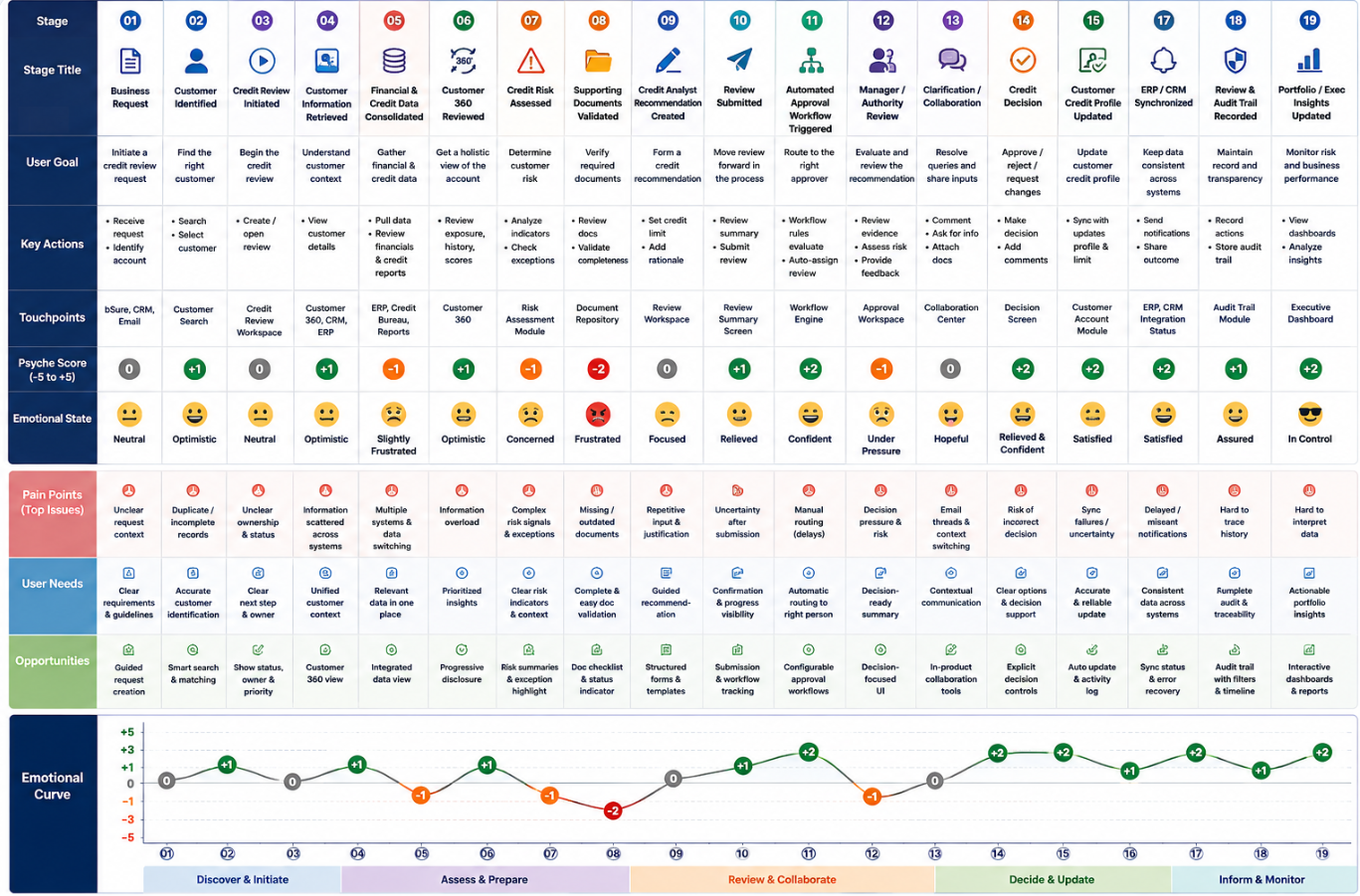
User journey map for credit review
Journey map — from pending review to ERP sync
05 · Flows & IA

A review that always knows where it stands.

Primary user flow
1Open dashboard, pick a pending review
2Review Customer 360 context and financials
3Validate documents, evaluate risk signals
4Create assessment, recommend a limit
5Submit — routed automatically by risk
6Manager approves, adjusts, queries or rejects
7Final approval syncs limit back to ERP
Information architecture
bSure
Dashboard
What needs my attention
Reviews
Pending, in review, awaiting approval
Customer 360
Overview, financials, risk, documents, activity
Assessment
Evidence, findings, recommendation
Approvals
Decisions and history
Administration
Policies, roles, thresholds
06 · Design system

Calm, data-dense and trustworthy.

A restrained navy palette and a strict Inter type scale keep dense financial data scannable — colour is reserved for risk and status.

Colours
Navy #1A2B4B
Steel blue #3E5C9A
Mist #F1F4F9
Slate #64748B
Typography · Inter

Aa

H1 Bold 48/56

H3 Semibold 20/28

Body Regular 15/24

Components
Data tableCustomer summary cardRisk signal chipWorkflow status + owner Approval timelineCurrency & date inputsDocument uploadAlerts, toasts, empty states
Low riskMediumHigh risk
07 · Low-fidelity

Structure first, pixels later.

bSure low-fidelity wireframes

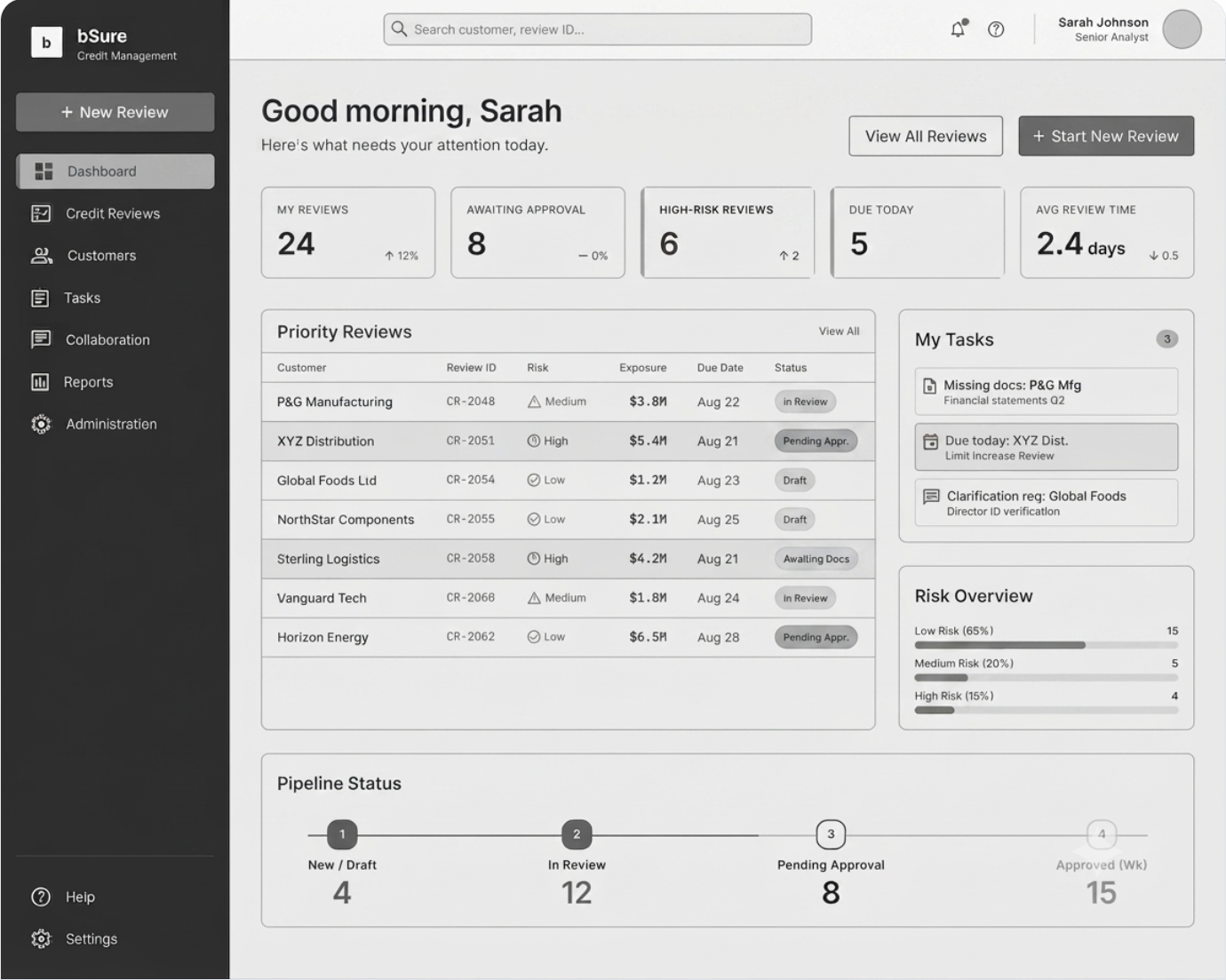
Wireframes — dashboard, review list and assessment workspace

08 · The solution

Shows what matters now.

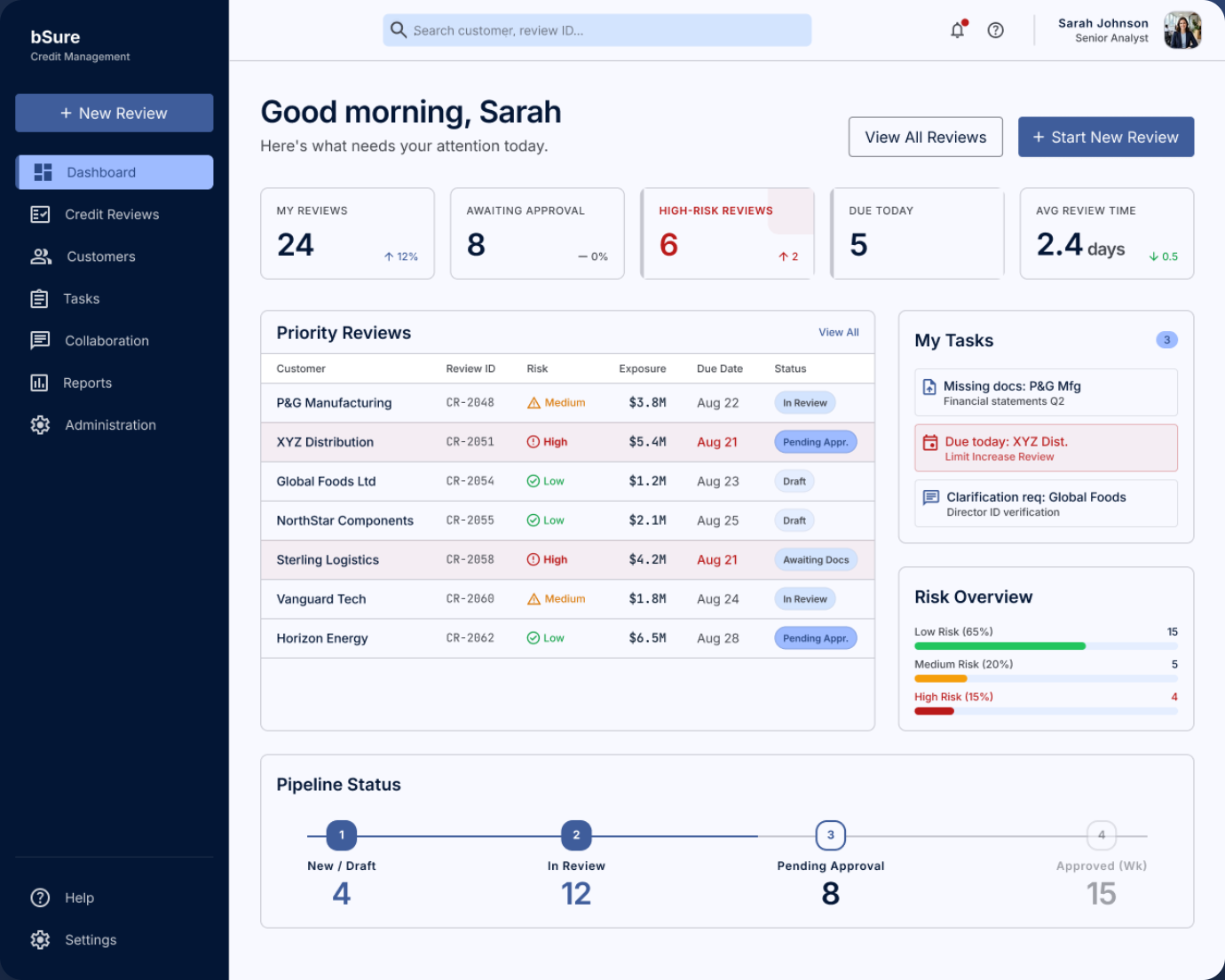
The Credit Operations Dashboard surfaces priority reviews, personal tasks and portfolio risk at a glance — with escalation rules flagging anything overdue.

bSure Credit Operations Dashboard high-fidelity design
Role-based views

Analysts, managers and executives see only what's relevant to them.

Configurable workflows

Two approval levels or ten — thresholds and escalation without custom code.

Collaboration in context

Sales resolves holds inside the review instead of email threads.

09 · Learnings

What this project taught me.

Lesson 01
Complexity belongs in the system.

Complexity should exist in the system, not in the user's workflow.

Lesson 02
Humans stay in control.

Automation should remove repetitive work while keeping humans in control of important decisions.

Lesson 03
Show what matters now.

A good enterprise dashboard doesn't show everything — it shows what matters now.

Next case study
WellNest — a calmer way to manage healthcare
View WellNest